



Triptychs and Trilogies

As you look through the pictures feel free to click on any to see a larger version of them. Many of the pictures have information written below so you can get a feel for how a particular piece was conceived and made in to reality.




Ag Criost an Siol
(Christ's is the Seed)
The words which inspired the painting come from a hymn written by the Irish composer, Sean O Riada (see text and translation below). I became familiar with this many years ago in Eire when I was in an Augustinian religious community. This hymn came back to me recently and has been the inspiration for this painting.
It is a kind of triptych, although not in the traditional sense. It is made up of three canvases, painted in acrylic and gold leaf, and was a joy to paint.
I wanted to convey a sense of a huge boat on the sea with the sky above. For me it was to symbolise Christ Himself, the ark, the Covenant between God and His people, the very body of the Church. Contained at the centre of this would be the apostles, representing each one of us brought to the table of Christ and the celebration of the Eucharist.
When you look at the painting it’s as if you are looking down from above onto the shape of a boat. It had not escaped me that this boat shape and the central panel could also be seen as an eye, and in that sense perhaps ii symbolizes the eye of God.
This boat is tossed about on ocean waves. Above the boat shape there is a vast expanse of sky with the suggestion of the rainbow in a curve above it which in the story of Noah and the Flood symbolises God’s promise of new life to His people.
In the middle of the boat blissfully held and contained is a seed, an oval shape surrounded with gold. Inside this seed is the figure of Christ and the twelve (men and women) seated at a round table -
Nigel Groom -
Please click on the YouTube clip above to hear “Ag Criost an siol”
Ag Criost an Siol
(Christ's is the Seed)
Ag Criost an siol Christ’s is the Seed
Ag Criost an siol Christ’s is the Seed
Ag Criost an fomhar Christ’s is the Harvest
I n-
go dtugtar sinn May we be brought
Ag Criost an mhuir Christ’s is the sea
Ag Criost an t-
i liontaibh de In the nets of God
go gcastar sinn May we be caught
O fhas go haois From Birth to age
is o aois go bas and from age to death,
do dha laimh a Criost May your two arms,
anall tharainn O Christ, be around us
O bhas go crioch From Death to the end
ni crioch ach ath-
I bParrthas na nGrast In the Paradise of Graces
go rabhaimid May we be
(Words by Sean O Riada)
The Transfiguration
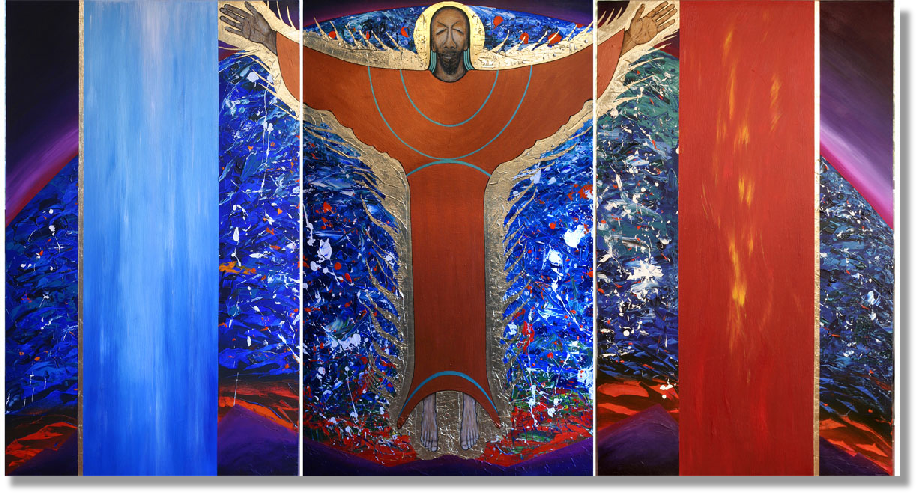
The Transfiguration
Acrylic and 24k gold leaf on deep edge canvas
275 cms x 153 cms
April 2011
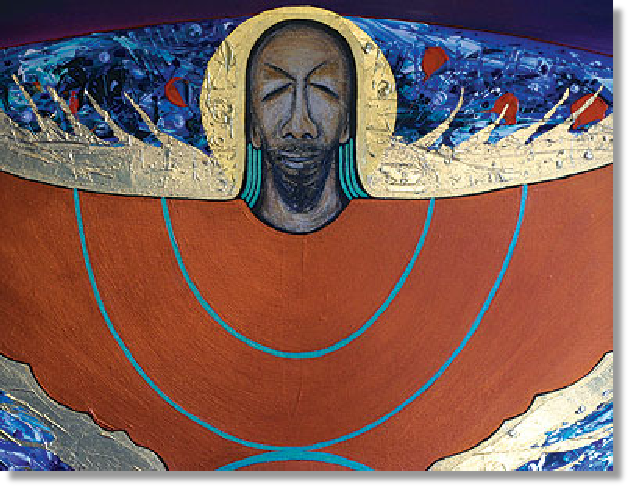
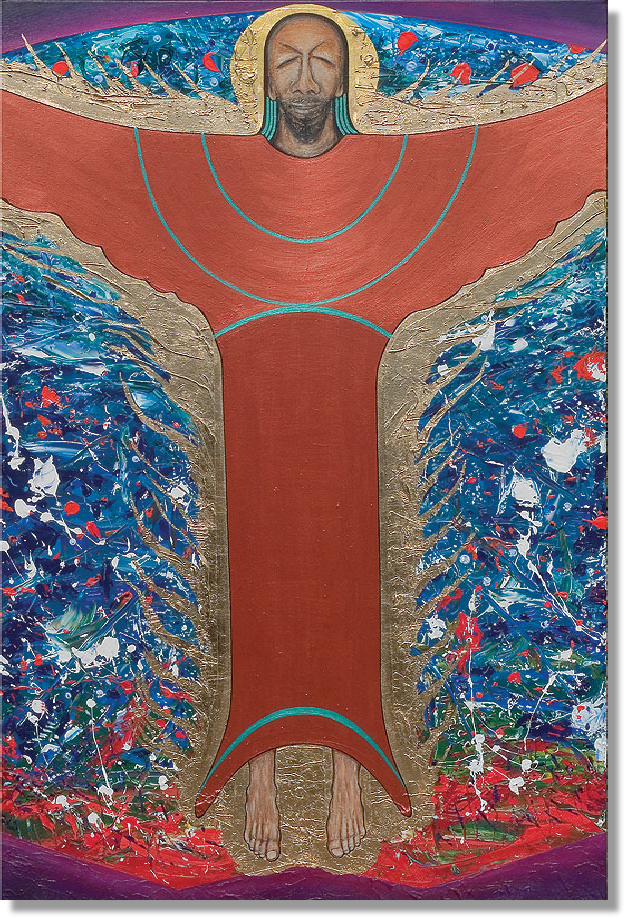
This painting in the style of a triptych was completed in 2011 and is the first of a series of three. The second, Lord of the Harvest, was completed in January 2012. The third is yet to be completed.
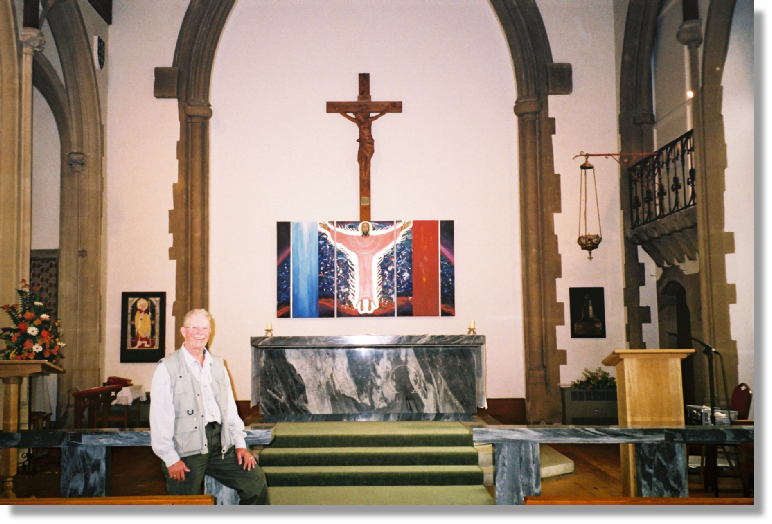
I am grateful to the Dean and Chapter of Worcester Cathedral who have kindly accepted this painting as a temporary installation in the Chapel of Prayer. Its display for the month of August coincides with the Feast of the Transfiguration (August 6th) which is also the remembrance day of the dropping of the atomic bomb on Hiroshima.
In the three panels, are representations of the figures at the centre of the Transfiguration event. Jesus, the largest figure at the centre, Elijah to the right and Moses to the left. The outstretched arms of the Christ figure extend into the panels on either side as if in total embrace. Christ, adorned with braided hair like a young king, black, radiant and phoenix-
The panel representing Moses is blue, a suggestion of a wall of water, symbolising the path through the Red Sea, the water of Jesus’ baptism, the water from the rock in the desert, the life-
The panel representing Elijah is red with yellow flame, suggesting prophecy, the power of God to purge and purify, the prophet’s assumption into heaven in a fiery chariot, the liberating and empowering flames of the Holy Spirit at Pentecost, the fire of love, desire and passion, capturing for a moment the mystery of God’s grace and power to transfigure and transform our lives.
Nigel Groom -
LORD OF THE HARVEST
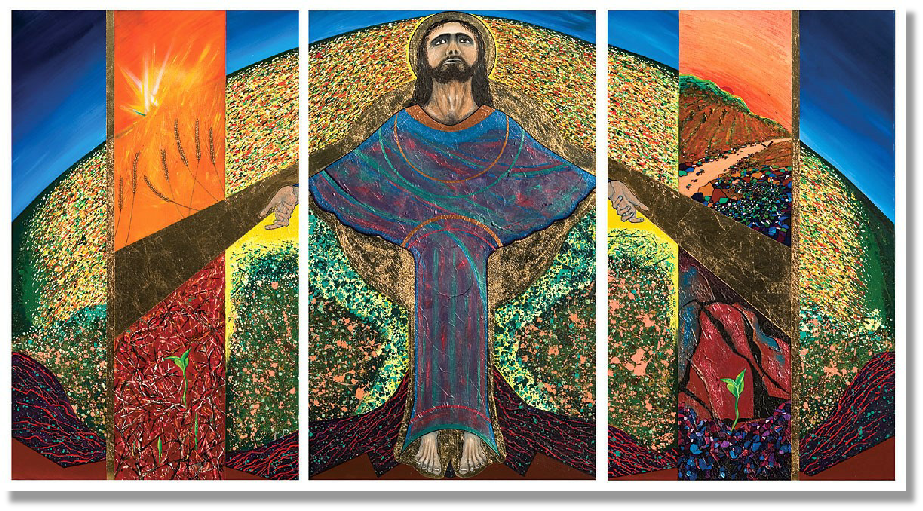
LORD OF THE HARVEST by Nigel Groom
Medium: Acrylic and gold leaf on canvas
Dimensions: 152 cms x 274 cms
Date: January 2012
Scriptural refs:
John 12: 20-
John 11: 25
Matthew 9: 38
Luke 8: 4-
Mark 4
This is the second “triptych” of three which I have had in mind to paint. The figure of Christ will be the central focus of each. I had originally imagined that all three might be displayed in one room or space, possibly an empty church. My intention is that the three would enfold a “sacred space” into which people could come for worship, prayer, meditation, sanctuary.
The first triptych of the three “The Transfiguration” was completed in 2011. It has to date, been exhibited in two churches, the Church of the Ascension in Malvern Link, and St Wulstan's at Little Malvern, Worcestershire. It will be displayed in Worcester Cathedral for the month of August to coincide with the Feast of the Transfiguration on August 6th 2012 (which incidentally is the anniversary of the dropping of the atomic bomb on Hiroshima).
I worked on Lord of the Harvest for about six months and completed it in January 2012. Other work has delayed my completing it but in a sense it has taken its own time and direction. Discerning and listening to the inner voice of the imagination has been a very rich part of the journey towards its completion. There were moments when I felt like abandoning it. I felt that it had lost impetus and inspiration but somehow there has been a hidden energy and life at work which more recently took a clear direction and allowed me to accomplish it.
The symbol of “the Seed” forms the kernel of the painting. I wanted to depict Jesus on the central panel as a Lord of all Creation, but primarily Lord of the Harvest. The Parable of the Sower in Luke and Matthew had early on been a driving force and an inspiration, however, I did not just want to paint a traditional depiction of the parable of the Sower but to expand it visually to include ideas of Word, Kingdom and Eucharist.
In the painting Christ symbolizes Seed itself. He is the Sower of the Seed, “Word of God”. I intended that the painting would express life and growth striving to find fulfillment and hope in the abundance of Harvest.
The figure of Jesus is painted arms outstretched offering himself to the world, to the Father, as Alpha and Omega, the beginning and the end. His upturned hands suggest he has thrown/sown the seed that springs into life from the earth. He seems to grow out of the roots of the earth at his feet. It's as if in the central part of the painting He becomes the Tree of Life as in one of the Genesis stories, and there too, are also the symbols of the bread and wine of the Eucharist.
To the left and right of the figure are two panels each with two distinct elements which hint at the Parable of the Sower. At the top of the right hand panel we see labourers in the field toiling to till the ground and plant the seed. The birds of the air are there too. The bottom right hand panel depicts a solitary fresh green plant surging up from rocks and stones. The plant thrives despite growing on rock. Similarly with the left hand panel, where, at the bottom we see three saplings coming to life through a thicket of brambles and thorns. The central plant is surrounded by a crown of thorns: new life is born even out of, or perhaps because of, pain and suffering. The top of the left hand panel shows seven abundant ears of corn depicting a rich sun-
The Easter song/carol “Now the Green Blade Riseth” came to mind as I was completing the painting:
Now the Green Blade Riseth
Now the green blade riseth from the buried grain,
Wheat that in dark earth many days has lain;
Love lives again, that with the dead has been:
Love is come again, like wheat that springeth green.
In the grave they laid him, love whom men had slain,
Thinking that never he would wake again.
Laid in the earth like grain that sleeps unseen:
Love is come again, like wheat that springeth green,
Forth he came at Easter, like the risen grain,
He that for three days in the grave had lain.
Quick from the dead my risen Lord is seen:
Love is come again, like wheat that springeth green.
When our hearts are wintry, grieving, or in pain,
Thy touch can call us back to life again;
Fields of our hearts that dead and bare have been:
Love is come again, like wheat that springeth green.
Words: John M.C. Crum, 1928
Notes by the Artist: Nigel Groom, February 2012
I Am Alive Forever
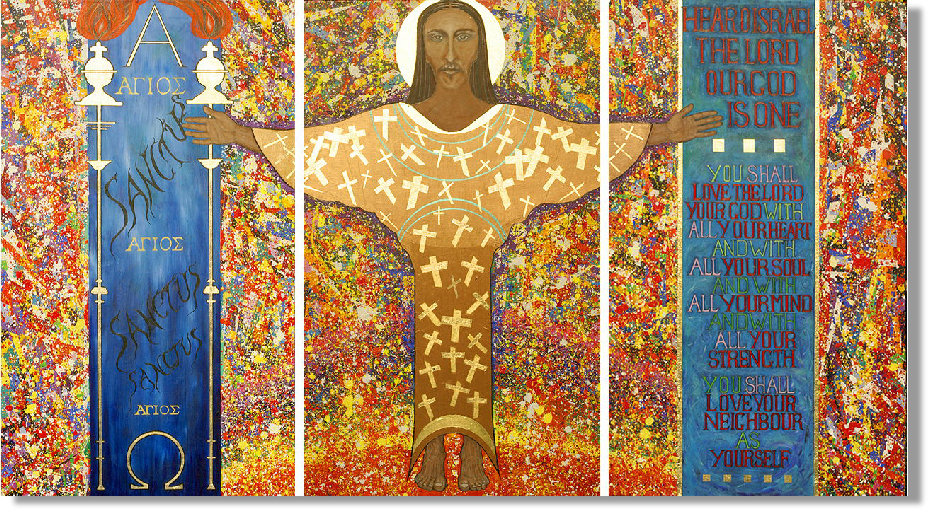
I Am Alive Forever
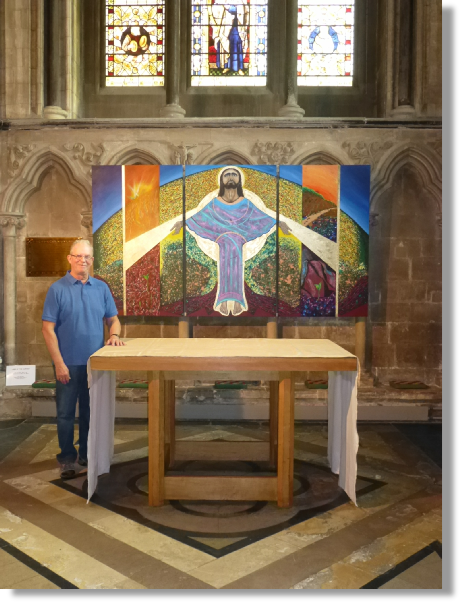
ARTIST: Nigel Groom
MEDIUM: Acrylic/gold leaf on deep edge canvas
DIMENSIONS: Three panels each 91cmsx153cms
DATE: Epiphany 2013
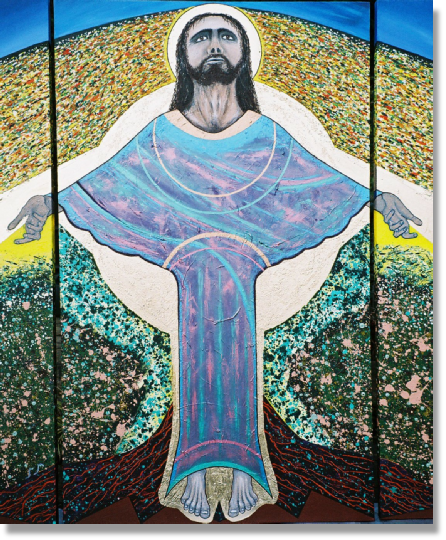
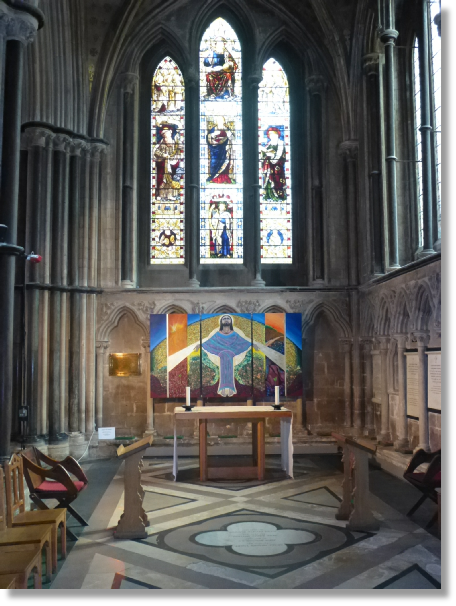
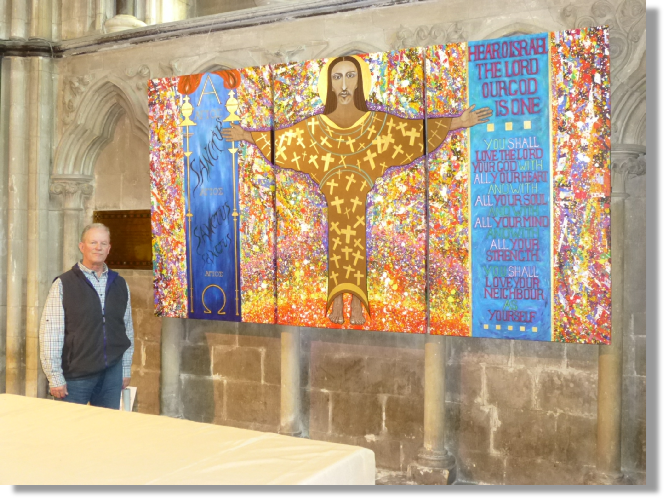
This painting in the style of a triptych is the third and last of three which have been in progress over the past three years. It was completed on the eve of the Epiphany, 5th January 2013.
As in the previous “triptychs”, The Transfiguration and Lord of the Harvest, the central panel is also a figure of Christ and depicts Him as resurrected and Lord of Life. It was inspired by a quotation from the Book of Revelation.
Book of Revelation Chapter 1: vv 17-
“Do not be afraid, I am the first and the last, and the living one. I was dead, and see, I am alive for ever and ever; and I have the keys of Death and of Hades”.
The image of the left hand panel depicts the prophet Isaiah’s vision in the Temple. It symbolizes the Holy of Holies, the very place of God's Presence. It weaves motifs of awesomeness and holiness in the words Sanctus, sanctus, sanctus (Holy, holy, holy) and the Greek word Agios -
Book of Isaiah: Chapter 6: vv 1-
“In the year that King Uzziah died, I saw the Lord sitting on a throne, high and lofty; and the hem of his robe filled the temple. Seraphs were in attendance above him; each had six wings; with two they covered their faces, and with two they covered their feet, and with two they flew. And one called to another and said: ‘Holy, holy, holy is the Lord of hosts; the whole earth is full of his glory.’ “
The right hand panel bears the words of the Shema, one of the main prayers in the Jewish Torah, and Jesus’ addition of the words “You shall love your neighbour as yourself” as the summation and completion of His teaching in the New Testament.
Gospel of Mark: Chapter 12 vv 28-
“One of the scribes came near and heard them disputing with one another, and seeing that he answered them well, he asked him, ‘Which commandment is the first of all?’ Jesus answered, ‘The first is, ‘Hear, O Israel: the Lord our God, the Lord is one, you shall love the Lord your God with all your heart, and with all your soul, and with all your mind, and with all your strength.’ The second is this, ‘You shall love your neighbour as yourself.’ There is no other commandment greater than these.”
Nigel Groom
Malvern April 2013
HYMN OF THE UNIVERSE
Artist: Nigel Groom
Medium: acrylic/acrylic ink/gold leaf
on deep edge canvas
Dimensions: three panels each 91cmsx91cms
Date completed: February 2015
My "triptych" of the Hymn of the Universe, completed this year, comprises three panels in acrylic, acrylic ink and gold leaf to depict a theme dear to my heart, that of the birth of the universe and the wonder of creation. Recent research in astrophysics and cosmology on the genesis of the universe, and its formation out of dark matter, has caused much excitement amongst cosmologists and physicists. As an artist who ponders the nature of existence and belief and who also values the insights and advances of scientific research I am inspired by these awesome discoveries.
I am most grateful to the Dean and Chapter for providing the opportunity for this work to be displayed in the Chapel of Prayer at Worcester Cathedral.
Nigel Groom
June 2015
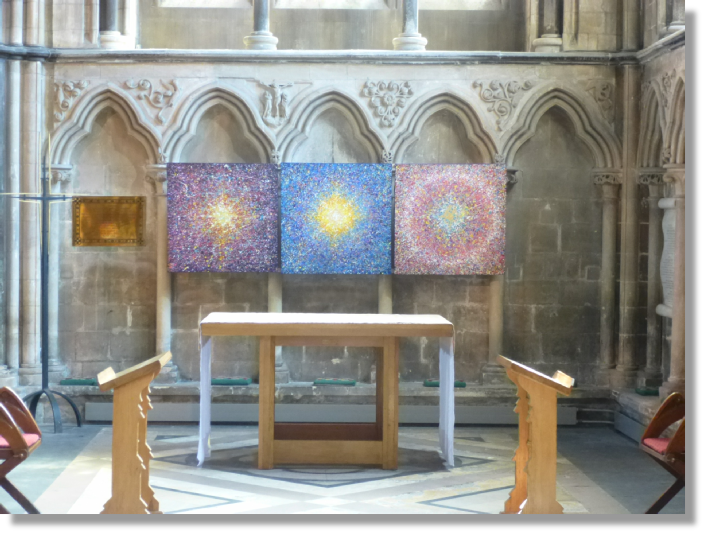
HYMN OF THE UNIVERSE
The Initiations of the Nazarene
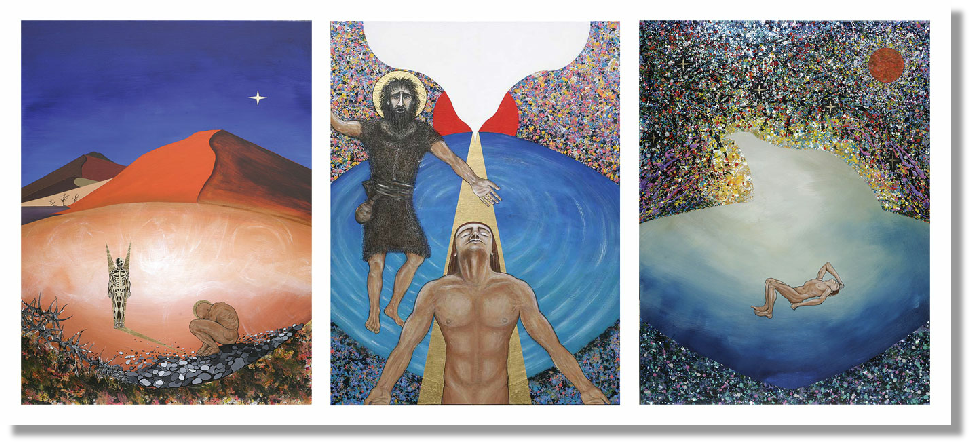

TITLE: THE INITIATIONS: 1. BAPTISM
ARTIST: NIGEL GROOM
MEDIUM: ACRYLIC/INK/GOLD LEAF
DIMENSIONS: 122cmsx91cms
DATE: FEBRUARY 2014
An initiation into the sacred mysteries -
The figures of John the Baptist, Jesus and the symbolic representation of Holy Spirit form the tension and focus of the painting. The image of Jesus can also be viewed as a sun-
There are allusions to the two protagonists Esau and Jacob in the Genesis accounts of the bestowal of birthright -
Nigel Groom 22nd February 2014
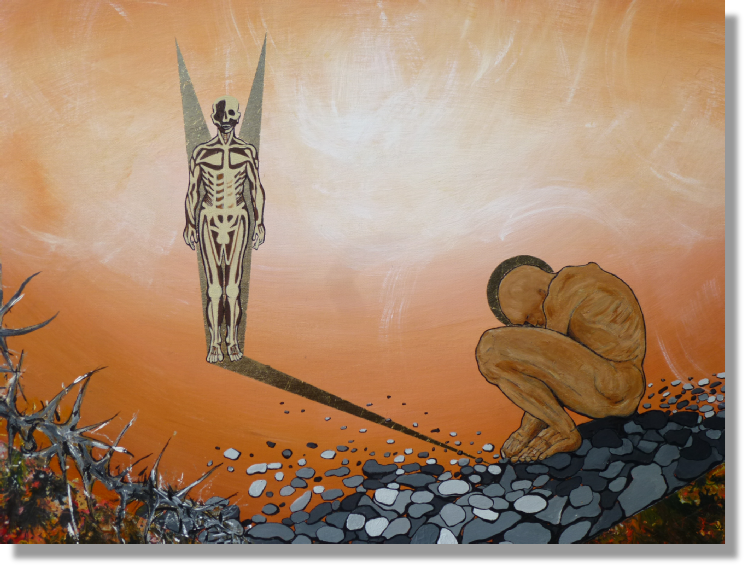
TITLE: THE INITIATIONS: 2. WILDERNESS
ARTIST: NIGEL GROOM
MEDIUM: ACRYLIC/INK/GOLD LEAF
DIMENSIONS: 122cmsx91cms
DATE: MARCH 2014
This painting is based on one of the Visions of Jesus in the Wilderness recorded in the Synoptic Gospels (Matthew 4:1ff, Mark 1:12ff and Luke 4:1ff). There are three visions of testing or “temptations”. These Visions can be understood as being significant parables or myths in the early church’s understanding of Jesus’ call and mission.
After Jesus has been “driven” or “led” by the Spirit into the desert or wilderness and his period of fasting, He is visited by the devil or Satan (the Diabolos – a diabolical figure). This painting is my interpretation of that first Vision. I allude to both devil and Satan figures from mythological sources for this picture. I have depicted the devil in this “Vision” as radiant with light and gold who confronts Jesus with the command to “turn the stones into bread”, if indeed, Jesus is who he claims to be.
The figures of Jesus and the devil are depicted naked. It is a stark and raw confrontation, stripped to bare muscle, flesh and bone. The figure of the devil is represented as having no shadow, only surrounded in golden light appearing as an Angel of light (Lucifer). The vision presents Jesus with an inner psychic struggle with his own shadow mirroring the devil or the “diabolos” within himself.
The Diabolos (devil or Satan)
The definition of Diabolos is, one who “throws across” (dia, across) and ballo, (“I throw”) Latin/Greek. He is the slanderer, the false accuser, the calumniator, one who spiritually speaking, opposes the cause of God.
The painting alludes to the figures of Job and Satan in the Old Testament. The figure of Satan is a character in Hebrew mythology whose most full representation is found in the first two chapters of the Book of Job. Job becomes the topic of conversation (on God’s initiative) and Satan suggests that Job only worships God because of the blessings he has received. So God allows Satan to remove first Job’s wealth (including his children) and, when that fails to make him bitter against God, his health. According to Jewish tradition, ha-
The Wilderness
Adjacent to Sossusvlei in the Namibian desert which I visited some years ago is the Deadvlei. This wilderness is a parched and apparently lifeless place, a vast sea of sand and rugged rock formations imbued with an air of timelessness. This desert bowl in the earth, created by nature’s powerful forces, lies in surreal silence. Its inhospitable, pale, cracked surface and naked dunes seemingly incapable of sustaining life.
This memory for me seemed to provide an ideal setting in which I could paint the encounter between the devil and Jesus. The towering dunes encircle and imprison the figure of Jesus in an amphitheatre of sand and reinforce the dynamic between him and the devil. There are hints in the picture of the suffering to come in the fulfillment of Jesus’ mission. The Passion and death of Gethsemane and Calvary are suggested by the three dead trees in the distance and thorn scrub in the foreground. There is a sense of new life and vibrancy in the huge orange sand dune which seems like a bird of fire, to be soaring heavenwards, and to the stars.
Nigel Groom 23rd March 2014
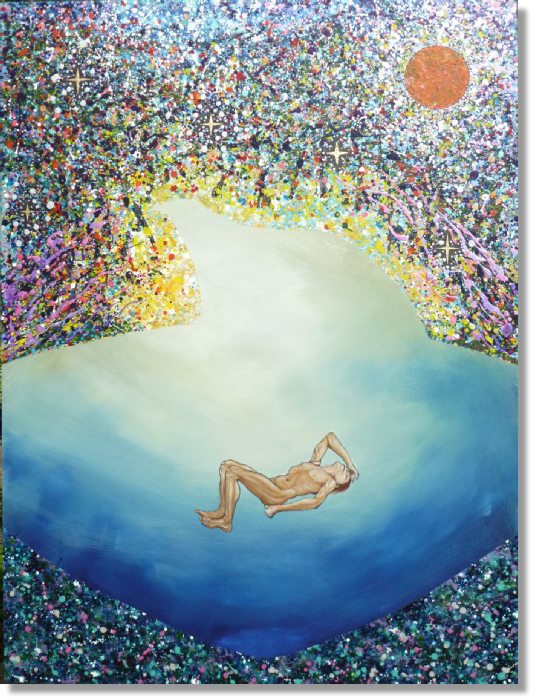
TITLE: THE INITIATIONS: 3.GETHSEMANE
ARTIST: NIGEL GROOM
MEDIUM: Acrylic/Ink/Gold leaf
DATE: 17th April 2014
Artist's Notes:
This painting is based on the accounts in the Gospels of Jesus' final night in the Garden of Gethsemane after celebrating the Last Supper with His disciples. The figure in the painting is that of Jesus facing His coming suffering and death by crucifixion.
I was inspired by the story of Jonah from the Old Testament who in the story spends three days and nights in the belly of the whale before being spewed out of the whales' mouth onto dry land. This theme can be understood as a renewal, rebirth and resurrection myth in its own way. Jesus can be seen as a type of hero figure and therefore the mythology of the hero seems apt in terms of his mission, trials, suffering and death, and eventual resurrection. This is not unlike the Osiris and Orpheus figures of Egyptian and Greek mythology. I believe that these myths have an universal significance and are archetypal in the human psyche and are pertinent to all human beings.
Why belly of the whale? In what way does this mythology comment on the figure of Jesus?
Belly of The Whale -
The belly of the whale represents the final separation from the hero's known world and self. By entering this stage, the person shows willingness to undergo a metamorphosis or transformation.
Campbell: "The idea that the passage of the magical threshold is a transit into a sphere of rebirth is symbolized in the worldwide womb image of the belly of the whale. The hero, instead of conquering or conciliating the power of the threshold, is swallowed into the unknown and would appear to have died. This popular motif gives emphasis to the lesson that the passage of the threshold is a form of self-
Nigel Groom 17 April 2014
The Tempest Trilogy
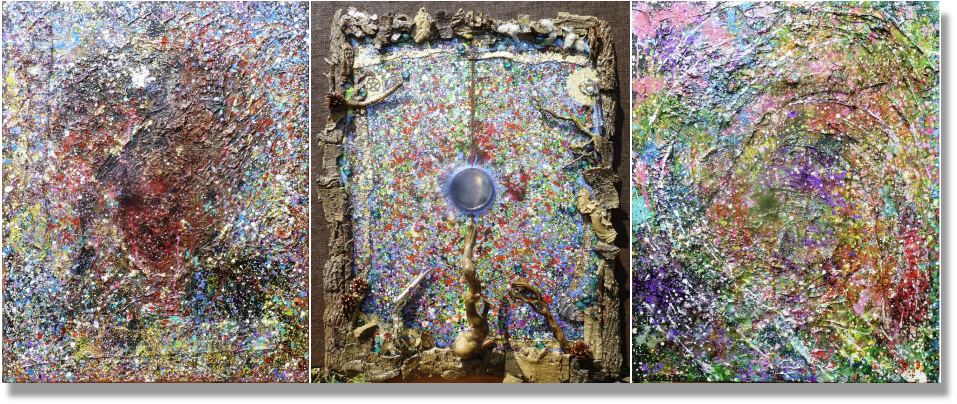
(Three art panels on Shakespeare)
(1) The Birthing of Caliban
(2) Song for Ariel
(3) Miranda
ARTIST: Nigel Groom
MEDIUM: Mixed media on canvas
DIMENSIONS: Three panels each 60cmsx75cms
DATE: July 2017
These three panels are a re-
After a re-
The Tempest is one of my favourite Shakespeare plays and for the artist inspires and touches the imagination on many levels. Being one of his last and greatest works it seems to me to be a summation of deep themes regarding the human condition. Not least of these are forgiveness of past wrongs and hurts, reconciliation with oneself and with others, the final letting go of one's power and the control by the Ego (as Prospero "breaks his staff and drowns his book"), and the attainment of simplicity, peace and consolation.
It feels somehow appropriate for me to be expressing these themes in my 70th year as I embark on new sights, sounds and adventures.
Be not afeard. The isle is full of noises,
Sounds, and sweet airs, that give delight and hurt not.
Sometimes a thousand twangling instruments
Will hum about mine ears, and sometime voices
That, if I then had waked after long sleep
Will make me sleep again; and then in dreaming
The clouds methought would open and show riches
Ready to drop upon me, that when I waked
I cried to dream again (III.ii.130–138).
Caliban in The Tempest by William Shakespeare
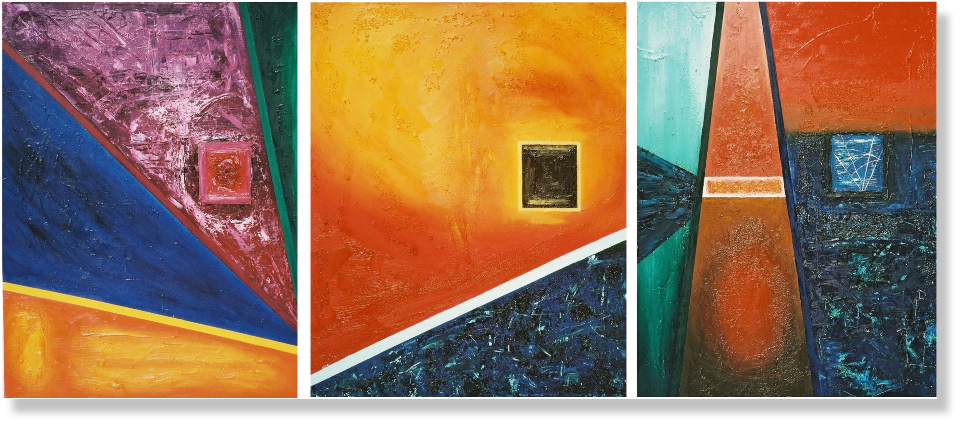
ARTIST: NIGEL GROOM
MEDIUM: OIL ON DEEP EDGE CANVAS
DIMENSIONS: THREE PANELS EACH 76CMSX61CMS
DATE: 2004
This triptych’s inspiration came from the one-
I have known this beautifully dark opera for many years and have loved Bartok’s music.
It really inspired me to paint this triptych.
For a Synopsis of this amazing Opera, please see the full text below.
To hear a short clip (The Opening of the Fifth Door) from the final rehearsal for the opera click on the video.
To see the complete opera (lasting about and hour) in a riveting performance click on the video below.
BLUEBEARD’S CASTLE – the drama of the opera
Place: A huge, dark hall in a castle, with seven locked doors.
Time: Not defined.
Judith and Bluebeard arrive at his castle, which is all dark. Bluebeard asks Judith if she wants to stay and even offers her an opportunity to leave, but she decides to stay. Judith insists that all the doors be opened, to allow light to enter into the forbidding interior, insisting further that her demands are based on her love for Bluebeard. Bluebeard refuses, saying that there are private places not to be explored by others, and asking Judith to love him but ask no questions. Judith persists, and eventually prevails over his resistance.
The first door opens to reveal a torture chamber, stained with blood. Repelled, but then intrigued, Judith pushes on. Behind the second door is a storehouse of weapons, and behind the third a storehouse of riches. Bluebeard urges her on. Behind the fourth door is a secret garden of great beauty; behind the fifth, a window onto Bluebeard's vast kingdom. All is now sunlit, but blood has stained the riches, watered the garden, and grim clouds throw blood-
Bluebeard pleads with her to stop: the castle is as bright as it can get, and will not get any brighter, but Judith refuses to be stopped after coming this far, and opens the penultimate sixth door, as a shadow passes over the castle. This is the first room that has not been somehow stained with blood; a silent silvery lake is all that lies within, "a lake of tears". Bluebeard begs Judith to simply love him, and ask no more questions. The last door must be shut forever. But she persists, asking him about his former wives, and then accusing him of having murdered them, suggesting that their blood was the blood everywhere, that their tears were those that filled the lake, and that their bodies lie behind the last door. At this, Bluebeard hands over the last key.
Behind the door are Bluebeard's three former wives, but still alive, dressed in crowns and jewellery. They emerge silently, and Bluebeard, overcome with emotion, prostrates himself before them and praises each in turn (as his wives of dawn, midday and dusk), finally turning to Judith and beginning to praise her as his fourth wife (of the night). She is horrified and begs him to stop, but it is too late. He dresses her in the jewellery they wear, which she finds exceedingly heavy. Her head drooping under the weight, she follows the other wives along a beam of moonlight through the seventh door. It closes behind her, and Bluebeard is left alone as all fades to total darkness.
(acknowledgements to Wikipedia)
%20Acrylic%20on%20board%201995.JPG)
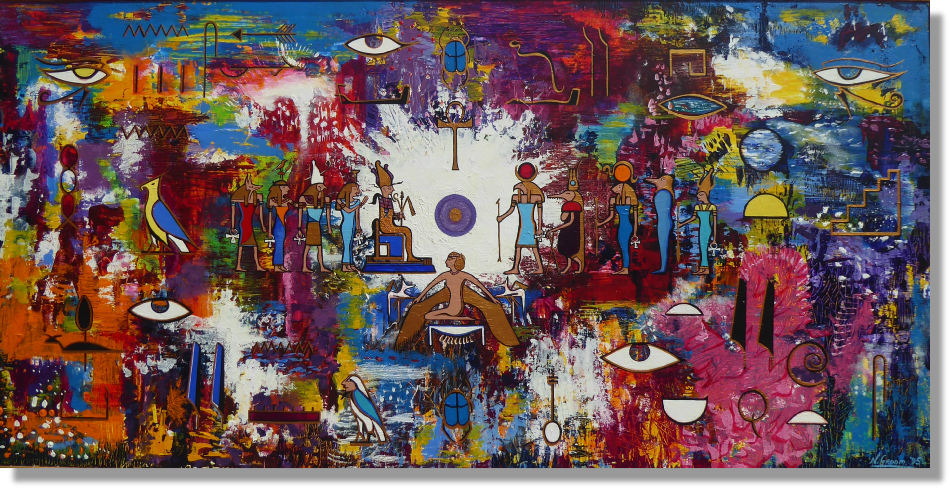
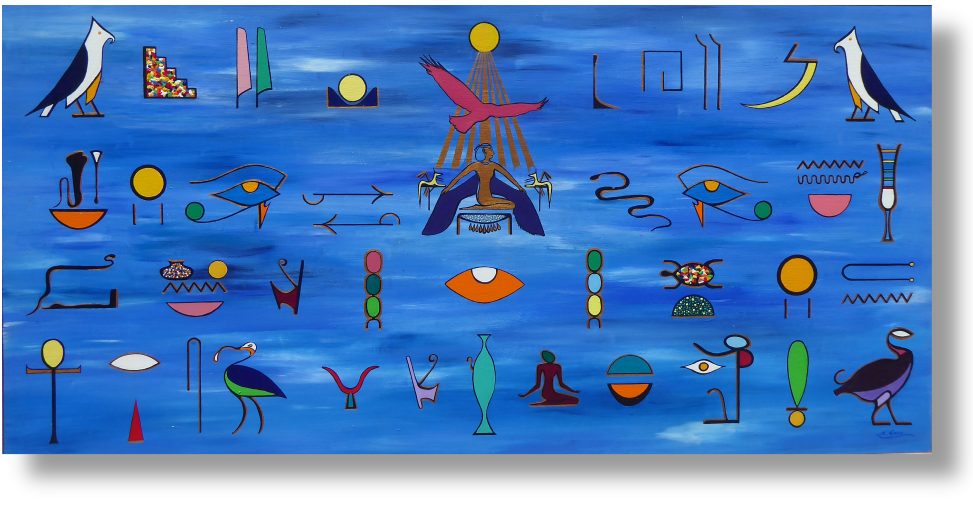
EGYPTIAN AMULETS AND INVOCATIONS 1, 2 and 3
Three panels Acrylic on board 1995
The artist writes:
From my childhood I have always been fascinated by mythologies of various cultures particularly those of the Greeks and of the Egyptians. I found they resonated something deep within me and in my imagination. My own visits to the pyramids at Giza in Egypt in 1970 and especially more recently in visits to the many ancient sites on the Nile from Luxor to Aswan, re-
In 1987 I first heard the Opera “Akhnaten” by Philip Glass and this work inspired me to paint these three panels of Egyptian heiroglyphics, calling them “Amulets and Invocations 1, 2 and 3”.
The more recent performances of “Akhnaten” at English National Opera and the Metropolitan Opera in New York have rekindled interest in this mesmeric work.
Here is the Director, Phelim MacDermott, talking about the opera.
In the following youtube clip Anthony Roth Costanzo, the countertenor who sings “Akhnaten” tells us about the role
Here is an excerpt from Akhnaten’s “Hymn to the Sun”
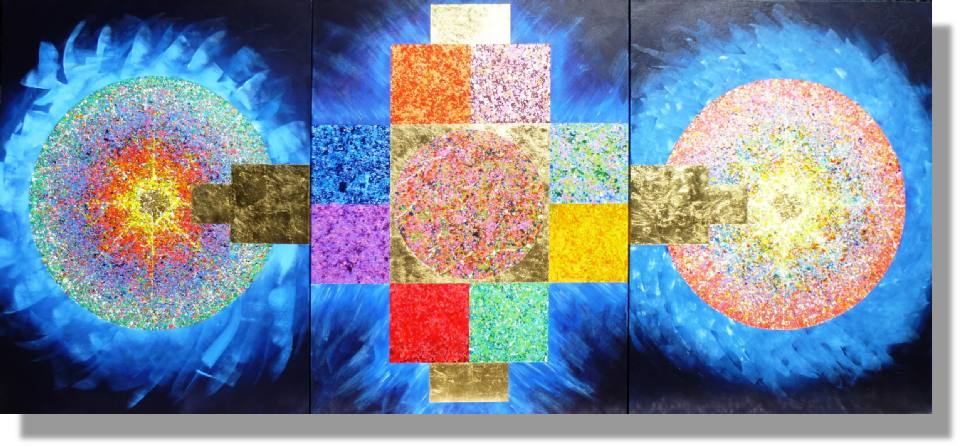
THE WORLD IS CHARGED
Artist: Nigel Groom
Medium: Acrylic/acrylic ink/goldleaf and foil
Dimensions: 273cmsx122cms
Date: September 2015
Press Release December 2015:
A second new triptych this year by Malvern artist Nigel Groom will be on display in the Chapel of Prayer in Worcester Cathedral during December and January. The painting is a single work on three large panels which will be hung as an altar piece.
Nigel writes: “For me all art is ‘spiritual’ in the best sense of that word. Inspired by the previous themes I have been working on of the scientific discoveries regarding the birth and death of stars, of dark matter, the cosmos and the Creation which were expressed in my painting of Hymn of the Universe shown earlier this year in Worcester Cathedral, this painting is a celebration for Christmas and Epiphany, a wonderfully life-
It combines motifs drawn from both Christian and Islamic art and is my attempt to embrace and bridge across the divides of religion and difference in difficult times to touch people’s hearts as well as their minds. It is about celebration, joy, light out of darkness, hope and peace for human kind and all creation.
The title is taken from Gerard Manley Hopkins’ wonderful poem (God’s Grandeur) on the awesomeness of nature and creation infused by the Spirit of Life and Love which resonates for each and every one of us and makes all things new. I am grateful to the Dean and Chapter of the Cathedral for the opportunity to display this painting for everyone to enjoy during this festive season."
The Very Reverend Peter Atkinson, Dean of Worcester comments: “It is good to welcome Nigel back to the Cathedral for the display of his new triptych. As he explains, Nigel has taken his title from Hopkins’ poem, God’s Grandeur. In the poem, Hopkins says: ‘And for all this, nature is never spent; there lives the dearest freshness deep down things’. It is, perhaps, the function of the artist to exhibit that ‘freshness’ to the rest of us, who too often are unaware of it. I have no doubt that Nigel’s work will enable us all to see the world with fresh eyes”.
Here is Gerard Manley Hopkins’ poem God’s Grandeur:
The world is charged with the grandeur of God.
It will flame out, like shining from shook foil;
It gathers to a greatness, like the ooze of oil
Crushed. Why do men then now not reck his rod?
Generations have trod, have trod, have trod;
And all is seared with trade; bleared, smeared with toil;
And wears man's smudge and shares man's smell: the soil
Is bare now, nor can foot feel, being shod.
And for all this, nature is never spent;
There lives the dearest freshness deep down things;
And though the last lights off the black West went
Oh, morning, at the brown brink eastward, springs —
Because the Holy Ghost over the bent
World broods with warm breast and with ah! bright wings.
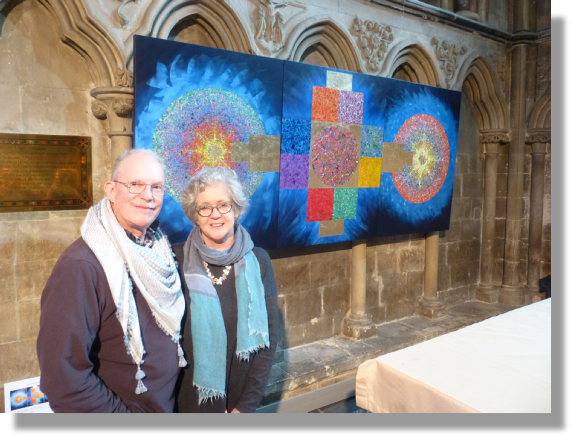
The artist together with the Chapter Secretary, Susie Arnold, December 2015.
“The World is Charged” displayed in the Chapel of Prayer, Worcester Cathedral, Christmas 2015.
THREE DOORS FROM BLUEBEARD’S CASTLE (A Triptych)
TRIPTYCH
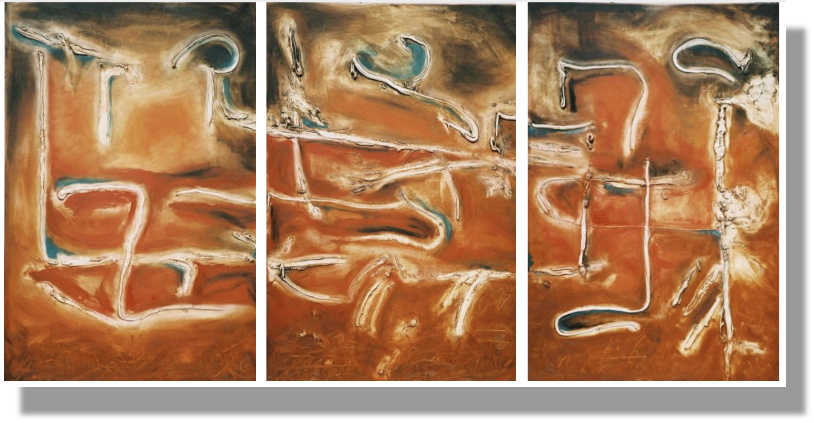
Oil/Impasto on deep edge canvas
245x120cms
2005
(Private commission)